Science Tutoring for Secondary Students: What Works Best

Introduction
Science lies at the heart of Dubai’s international school curricula, from the Cambridge IGCSE Triple Sciences to A-Level Biology, Chemistry, and Physics, as well as the IB Diploma’s Group 4 subjects. Yet for many students, science presents a particular challenge because it demands conceptual understanding, practical application, and mathematical fluency all at once.
International studies highlight that secondary students often lose confidence in science around mid-adolescence (OECD, 2021). This decline is not caused by lack of ability but by gaps in conceptual clarity and engagement. Targeted tutoring, grounded in evidence-based teaching strategies, can bridge this divide and transform science learning from memorisation to mastery.
1. Diagnosing Misconceptions Early
Science misconceptions are deeply persistent. Students may hold intuitive but inaccurate beliefs, such as “heavier objects fall faster” or “plants absorb food through roots.” These ideas can resist correction even after formal teaching. Research by Driver et al. (1994) shows that conceptual change requires more than explanation; it demands guided confrontation of these misconceptions.
Effective tutors therefore:
- Use diagnostic questioning or mini-assessments to reveal prior conceptions.
- Encourage students to articulate their reasoning aloud.
- Design practical or visual demonstrations that challenge faulty logic.
This targeted approach transforms tutoring from re-teaching content to rebuilding understanding.
2. Focusing on Core Concepts and Transferable Principles
High-performing science tutors focus on big ideas such as energy transfer, equilibrium, cell function, or particle theory, rather than isolated facts. These conceptual frameworks underpin multiple topics and exam questions.
Hattie (2009) notes that deep conceptual understanding produces higher retention and transfer across topics. For example, understanding the conservation of energy supports problem-solving in both physics and chemistry.
Tutoring should therefore:
- Emphasise conceptual maps linking related topics.
- Use analogies and models to simplify abstract ideas.
- Connect science to everyday contexts, which is vital for engagement in Dubai’s multicultural classrooms.
3. Integrating Practical and Inquiry-Based Learning
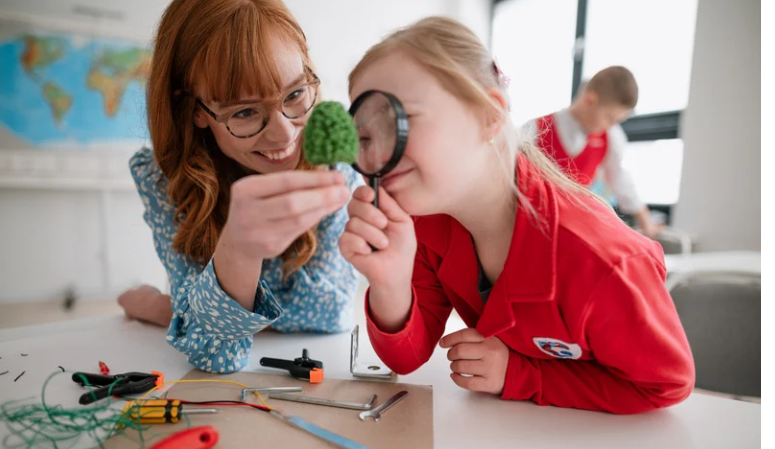
Science is not a spectator subject. Students learn best when they engage in hands-on, inquiry-based experiences that replicate real scientific thinking.
Effective tutoring sessions:
- Use simulations, experiments, or virtual labs to build practical confidence.
- Teach students to form hypotheses, design fair tests, and interpret results.
- Incorporate IB-style scientific investigation approaches to encourage independence.
Meta-analyses by Furtak et al. (2012) confirm that inquiry-based learning significantly improves conceptual understanding when coupled with guided instruction, which is the precise balance expert tutors provide.
4. Strengthening Exam Technique and Data Literacy
GCSE, A-Level, and IB exams demand not only scientific knowledge but also data analysis, graph interpretation, and extended-response writing. Many students lose marks not for misunderstanding science but for misreading questions or failing to express answers clearly.
Tutors help by:
- Teaching command words such as “explain,” “evaluate,” and “justify,” and clarifying what each requires.
- Modelling structured responses using scaffolds such as PEEL (Point, Evidence, Explain, Link).
- Reinforcing numeracy and data skills essential for practical-based papers.
The Education Endowment Foundation (EEF, 2021) reports that explicit instruction in metacognitive and self-regulatory strategies, including planning, monitoring, and evaluating answers, has a high impact on science achievement.
5. Addressing Confidence and Motivation
Science anxiety is a real phenomenon, particularly in physics and chemistry, where mathematical reasoning can intimidate students. Effective tutoring focuses as much on mindset as on material.
Tutors build confidence by:
- Normalising error as part of the scientific process.
- Using formative praise for effort and reasoning rather than correctness.
- Helping students recognise progress through visible improvement in mock exam data.
As Dweck (2017) notes, a growth mindset, the belief that intelligence can develop through effort and feedback, is especially powerful in STEM subjects where persistence and curiosity drive understanding.
6. Aligning Tutoring with Dubai’s International Curricula
Dubai’s international schools follow globally benchmarked curricula, each with distinct scientific emphasis.
- IGCSE or GCSE focuses on structured exam technique, core practicals, and recall precision.
- A-Level prioritises analytical reasoning, experimental design, and extended-response writing.
- The IB Diploma promotes conceptual inquiry, interdisciplinary connections through TOK and the Extended Essay, and data interpretation.
Tutors familiar with these frameworks ensure lessons target specific assessment objectives. This distinction separates casual help from professional, curriculum-aligned tutoring.
Conclusion
Effective science tutoring is not about covering more content but about teaching smarter. By diagnosing misconceptions, building conceptual frameworks, incorporating inquiry, and fostering confidence, tutors can unlock scientific potential in every learner.
For families in Dubai, high-quality science tutoring offers more than improved exam results; it cultivates curiosity, critical thinking, and lifelong learners who are ready for the challenges of the future.
At Tutor Chooser, we connect parents with verified, research-informed science tutors who combine curriculum expertise with the ability to inspire.
References
Driver, R., Squires, A., Rushworth, P., & Wood-Robinson, V. (1994). Making Sense of Secondary Science: Research into Children’s Ideas. Routledge.
Dweck, C. (2017). Mindset: Changing the Way You Think to Fulfil Your Potential. Robinson.
Education Endowment Foundation (EEF). (2021). Improving Secondary Science. EEF.
Furtak, E. M., Seidel, T., Iverson, H., & Briggs, D. C. (2012). Experimental and Quasi-Experimental Studies of Inquiry-Based Science Teaching: A Meta-Analysis. Review of Educational Research, 82(3), 300–329.
Hattie, J. (2009). Visible Learning: A Synthesis of Over 800 Meta-Analyses Relating to Achievement. Routledge.
Organisation for Economic Co-operation and Development (OECD). (2021). PISA 2021 Science Framework. OECD Publishing.